
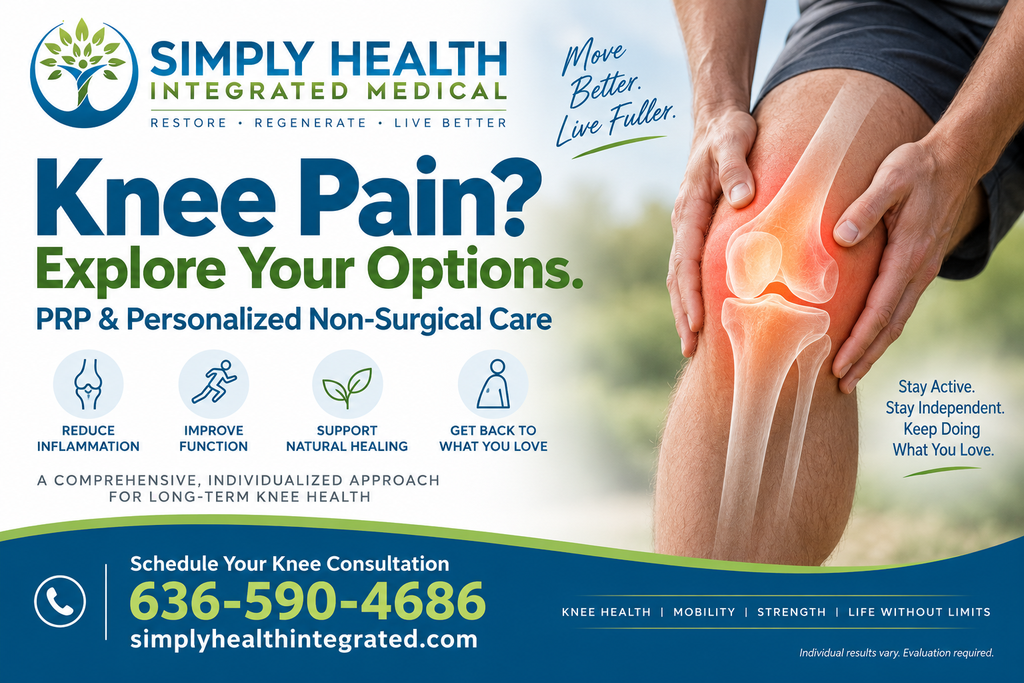
Knee Pain Relief: Exploring Regenerative Therapies
Getting out of a chair should not require a strategy. Walking the dog, climbing stairs, or playing with grandchildren should not revolve around knee pain. Yet stiffness, swelling, and aching can gradually make ordinary activities feel difficult. The good news: there are options worth exploring before assuming surgery is your only choice. [1]
At Simply Health Integrated Medical, we start with an important question: What is contributing to your knee pain, and which treatments make sense for you? Our goal is to help you understand your options and create a personalized plan focused on comfort, mobility, and everyday function. [4]
Start with the cause
Knee pain can involve arthritis, previous injuries, inflammation, or problems affecting the joint’s supporting structures. An evaluation considers your symptoms, medical history, strength, stability, and movement. Imaging may be appropriate. Understanding the problem helps determine whether rehabilitation, an injection, or specialist care is the right next step. [1]
Where regenerative therapies fit
One option receiving attention is platelet-rich plasma, or PRP. This treatment uses a sample of your own blood, processed to concentrate platelets before injection. Platelets contain growth factors, proteins involved in the body’s normal healing response. Researchers are studying how these signals may influence inflammation and symptoms within an arthritic knee. [1,2]
For some people with mild to moderate knee osteoarthritis, PRP may reduce pain and improve function. However, research results vary, and benefits are not guaranteed. PRP has not been established as a way to regrow lost cartilage or reverse arthritis. The aim is symptom improvement, not a promise of a new knee. [1,2]
Think beyond the injection
A knee care plan should also address how the joint functions every day. Targeted strengthening, flexibility work, and appropriate low-impact exercise can improve pain and function. Weight management, when needed, reduces stress on the knees. Selected patients may benefit from bracing to improve stability or redistribute pressure. These foundations matter whether or not an injection is part of your care. [1]
Success should be measured by more than a pain score. Can you stand longer, climb stairs more comfortably, or return to activities you have avoided? Clear goals and follow-up help determine whether your plan is making a meaningful difference. When improvement falls short, the next step is reassessment, not assuming that more of the same treatment will always work better.
Treatment decisions should include a discussion of expected benefits, costs, alternatives, and risks, including temporary soreness and infection. Not everything marketed as regenerative has the same evidence: stem-cell and
exosome products are not FDA-approved treatments for knee arthritis. Severe arthritis may still require surgical evaluation. [1,2,3]
Ready to explore your options?
You deserve more than a generic recommendation or a promise that sounds too good to be true. At Simply Health Integrated Medical, we help you evaluate whether PRP and personalized, non-surgical knee care may fit your needs. Bring your questions, your goals, and any previous imaging or treatment records. [4]
Call Simply Health Integrated Medical today at 636-590-4686 or visit simplyhealthintegrated.com to schedule your knee consultation. [4]
Take the first step toward moving with greater comfort and confidence, and getting back to the activities that matter most to you.
Dr. Bryan Deloney, D.C., MSHNFM
Simply Health Integrated Medical
Leave a Reply